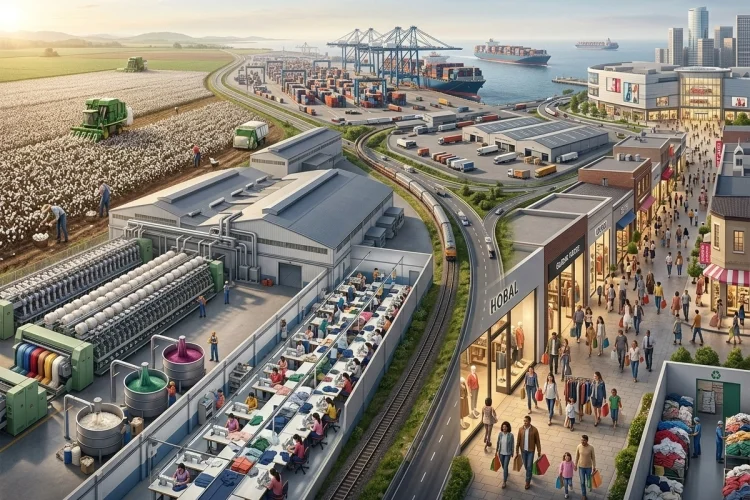
A basic T-shirt may travel through several countries before reaching your wardrobe. Cotton might be grown in one place, spun into yarn somewhere else, dyed and knitted in another country, sewn in a garment factory, and finally shipped to a retailer thousands of kilometres away.
This international journey is the foundation of the modern fashion business. Understanding how the global fashion industry works means looking beyond designers and runway shows.
Fashion is a huge network connecting farmers, chemical producers, textile mills, garment workers, logistics companies, technology platforms, photographers, marketers, retailers, repair services, recyclers, and consumers.
The sector also operates at an enormous scale. More than 90 million people work in textiles and clothing worldwide, with women forming a large share of the workforce. Meanwhile, global fibre production reached approximately 132 million tonnes in 2024.
This guide follows clothing through the global fashion supply chain, explaining who makes the key decisions, how companies earn money, and why speed, cost, labour, and sustainability are closely connected.
Fashion Begins With Consumers and Market Research
Before a garment is designed, fashion companies try to understand what customers may want. They study previous sales, social-media activity, search data, competitor products, economic conditions, street style, and cultural trends.
A company may notice growing demand for relaxed office clothing, lightweight travel garments, or running-inspired footwear. Designers and merchandisers then translate that information into possible products.
The process varies by business model. A luxury house may emphasise creative direction, craftsmanship, scarcity, and brand heritage.
A sportswear company may focus heavily on performance and technology, while a mass-market retailer usually needs accessible prices and products that appeal to a much larger customer base.
The important point is that fashion design is both creative and commercial. A garment must look appealing, but companies also consider its target price, production time, expected sales, and place within the wider collection.
Designers and Merchandisers Plan the Collection
Designers develop silhouettes, colours, prints, construction details, and fabric ideas. They may begin with drawings, mood boards, historical research, or physical experiments with fabric.
Merchandisers look at the collection from a business perspective. They help decide how many dresses, shirts, trousers, jackets, and accessories the company should offer. They may also recommend price points, colour options, size ranges, and order quantities.
These roles need to work together. A collection made entirely from dramatic statement garments may attract attention but fail to meet customers’ everyday needs. On the other hand, a collection containing only safe basics may struggle to create a strong brand identity.
Once the main ideas are approved, technical designers and product developers turn creative drawings into measurable instructions. These can include garment dimensions, fabric specifications, stitching details, labels, trims, and packaging requirements.
Raw Materials Form the First Supply-Chain Stage
Clothing starts with fibres. Natural fibres include cotton, wool, linen, silk, and hemp, while common synthetic materials include polyester, nylon, acrylic, and elastane.
These raw materials may come from agriculture, livestock, forestry, recycling systems, or the petrochemical industry. They are processed into fibres, spun into yarn, and then woven or knitted into fabric.
Polyester is currently the world’s most widely produced fibre. It accounted for about 59% of global fibre output in 2024, and most polyester production remained based on fossil-derived raw materials.
Fashion brands do not always purchase raw fibres directly. They may work through fabric mills, sourcing agents, material suppliers, or manufacturing companies that manage several production stages.
This can make supply chains difficult to trace. A brand may know which factory sewed a shirt but have less visibility into the mill that dyed the fabric or the farm that produced its cotton.
Textile Mills Turn Fibres Into Fabric
After fibres are spun into yarn, textile mills transform them into usable material. Fabric may be woven, knitted, felted, bonded, or produced through another construction method.
The material then goes through processes such as bleaching, dyeing, printing, washing, coating, or softening. These treatments determine its colour, surface, drape, water resistance, texture, and final appearance.
A fashion company usually requests fabric samples before committing to a large order. The development team checks whether the material has the correct weight, shade, stretch, durability, and price.
Colour approval can require several rounds because a shade viewed on a computer screen may look different when applied to cotton, wool, or polyester. The company may also test shrinkage, colourfastness, pilling, or strength before allowing the fabric to enter production.
The textile stage can have significant environmental effects through energy consumption, water use, chemical processing, and wastewater. UNEP therefore treats improvements in production practices and infrastructure as essential parts of a more sustainable textile value chain.
Garment Factories Cut and Sew the Clothes
Once the fabric and design are approved, garment manufacturing begins. Pattern pieces are arranged across layers of fabric, cut into shape, bundled by size, and sent to sewing lines.
In a large factory, one worker may repeatedly sew sleeves while another attaches collars or closes side seams. Dividing production into specialised operations helps factories make large quantities consistently.
Factories may produce clothing for several international brands rather than owning the products themselves. The brand places an order, provides specifications, negotiates the price, sets the delivery date, and checks whether the finished garments meet its standards.
Some factories subcontract parts of an order to other facilities, particularly when deadlines are tight or specialised skills are required. This can make oversight more difficult when brands do not have visibility beyond their direct suppliers.
Global garment and footwear supply chains include formal factories, informal workshops, homeworkers, farmers, and self-employed workers.
The OECD recommends that companies use due diligence to identify and address labour, environmental, and human-rights risks throughout these networks.
Brands Have Significant Power Over Suppliers
Global fashion is often described as a buyer-driven industry. Large brands and retailers may control product design, marketing, order volumes, prices, and deadlines without owning the factories that manufacture their clothes.
This arrangement gives brands flexibility. They can source one collection from several countries or move future orders when costs, trade rules, capacity, or delivery times change.
However, pressure for low prices and rapid production can affect factory conditions.
Research by the International Labour Organization connects purchasing practices-including price negotiation, order changes, and production deadlines-with wages, working hours, temporary employment, outsourcing, and workplace safety.
A brand may publish a factory code of conduct, but responsible sourcing also requires realistic production schedules and prices that allow suppliers to meet labour standards.
The ILO and International Finance Corporation operate Better Work, which brings together brands, factories, governments, employers, and worker organisations to improve conditions and competitiveness in garment-producing countries.
Logistics Connect the International Supply Chain
Finished garments must travel from factories to distribution centres, stores, or customers. Transport may involve trucks, trains, cargo ships, and aircraft.
Sea freight is generally slower but more economical for large orders. Air freight is much faster, although it is usually more expensive and has a higher environmental impact.
Fashion is particularly sensitive to delivery schedules. A winter coat arriving after the cold season or a trend-led item reaching shops too late may need to be discounted.
International trade rules, customs procedures, tariffs, port congestion, currency changes, and political disruptions can all affect cost and delivery.
The WTO treats textiles and clothing as a major global value chain in which manufacturing stages and commercial activities are spread across multiple economies.
To reduce risk, some companies use several supplier countries or move part of their production closer to major consumer markets. This approach is sometimes called nearshoring.
Retailers Sell Through Stores and Digital Platforms
Once the clothing reaches the market, retailers sell it through physical shops, websites, apps, online marketplaces, department stores, or social-media platforms.
The retail price is not simply the factory cost plus a small profit. It may need to cover design, materials, manufacturing, transport, import duties, warehousing, staff, rent, photography, marketing, packaging, unsold stock, returns, and taxes.
Retailers monitor sales closely after launch. Strong products may be reordered, while slower items may be discounted. This is why end-of-season sales are so common: companies need to clear old inventory and free space for new collections.
Online shopping has changed logistics by increasing expectations for fast delivery, real-time tracking, convenient returns, and constantly updated product availability.
UN Trade and Development describes clothing as a time-sensitive industry in which e-commerce has increased both delivery pressure and the need to process large volumes of returns.
Marketing Creates Demand and Brand Value
Fashion companies do not sell fabric and stitching alone. They also sell stories, identities, lifestyles, and social meaning.
Marketing may involve runway shows, advertising campaigns, celebrity partnerships, influencers, magazine editorials, product placement, events, email promotions, and personalised digital recommendations.
A simple bag can sell for very different prices depending on its materials, construction, scarcity, reputation, design, and brand image. In some parts of fashion, the emotional and symbolic value of a product can be as commercially important as its practical function.
Social media has accelerated trend circulation. A garment can receive global attention within hours, encouraging brands to respond quickly with similar colours, silhouettes, or styling ideas.
However, online attention does not always produce long-term demand. Companies still risk creating excess inventory when viral interest disappears before production is complete.
What Happens to Unsold and Unwanted Clothing?
The fashion supply chain does not end when a garment reaches the customer.
Clothes may be repaired, resold, rented, donated, exported, recycled, repurposed, incinerated, or sent to landfill. Unsold products can also be discounted, transferred to outlet stores, or handled by liquidation businesses.
Recycling textiles is more complicated than placing garments in a collection bin. Clothing may combine cotton, polyester, elastane, zips, buttons, coatings, dyes, and decorative materials that are difficult to separate.
UNEP argues that the industry needs to reduce production volumes, design more durable garments, and keep clothing and materials in use for longer.
Its global textile roadmap prioritises changing consumption patterns, improving industry practices, and investing in systems that support circularity.
This means the future of fashion will depend not only on selling new products but also on repair, resale, rental, recycling, traceability, and more responsible production planning.
The global fashion industry is a connected system that moves clothing from raw fibres to textile mills, design studios, garment factories, distribution centres, retailers, and eventually consumers.
Every stage involves different businesses, workers, technologies, costs, and risks. Brands coordinate much of this process, but farmers, mill workers, sewing operators, logistics teams, marketers, shop staff, repairers, and recyclers all contribute to the final product.
The next time you examine a garment, check its fibre content, country of origin, construction, price, and brand information. Then consider how many people and production stages may sit behind it.
Understanding the supply chain can help you recognise clothing’s real complexity-and make more informed decisions about what you buy, wear, and keep.