Have you ever saved dozens of outfits on Pinterest or Instagram, only to open your closet the next morning and still think, “I have no idea what to wear”?
The problem may not be a lack of inspiration. You probably have plenty of it. The challenge is turning scattered images into a clear visual direction that actually reflects the way you want to dress.
That is exactly where a personal style mood board can help.
Learning how to create a personal style mood board gives you a visual reference for your favorite colors, silhouettes, textures, accessories, and overall fashion aesthetic.
Instead of buying random pieces because they look good individually, you begin to notice what belongs together and what genuinely fits your lifestyle.
Mood boards are widely used in creative fields because they help turn abstract ideas into a more concrete visual direction.
And you do not need to be a stylist or fashion designer to make one. You just need curiosity, a few good sources of inspiration, and a willingness to edit.
1. Start by Deciding What You Want Your Style to Feel Like
Before collecting hundreds of outfit pictures, think about the bigger question: how do you want your personal style to feel?
Maybe you want to look polished but relaxed. Perhaps you prefer something minimal, artistic, sporty, romantic, vintage-inspired, or slightly edgy.
Try choosing three to five descriptive words.
For example, your words might be:
Relaxed, modern, refined, neutral, practical.
These words become a filter for everything you add later.
If you save an elaborate evening gown because it looks beautiful but your goal is a casual, practical wardrobe for everyday life, it probably does not belong on your main style board.
Your inspiration should reflect both your taste and your actual lifestyle.
Vogue’s discussions of personal style similarly emphasize individuality, experimentation, and identifying what genuinely feels right rather than simply following every trend.
2. Collect Inspiration Without Overthinking It
Now comes the fun part: gathering images.
At this stage, do not analyze everything too deeply. Save outfits that immediately attract you, even if you cannot explain why.
You can find inspiration in fashion magazines, runway photography, street style, movies, vintage photographs, online stores, Pinterest, social media, or even people you see in everyday life.
A digital mood board can also include more than complete outfits. Canva notes that mood boards can contain photography, illustrations, colors, textures, and descriptive words that establish a visual direction.
So save details too.
Maybe you love the texture of suede, the shape of a structured handbag, silver jewelry, oversized sunglasses, loose linen shirts, or dark brown leather shoes.
Look Beyond Fashion Images
Some of your most useful inspiration may not involve clothes at all.
Architecture, hotel interiors, paintings, cars, landscapes, album covers, and movie scenes can communicate atmosphere.
For example, if you repeatedly save warm wooden interiors, cream walls, olive green objects, and vintage photography, those preferences might suggest an earthy, understated fashion palette.
That is one reason a good mood board feels more personal than a simple collection of trendy outfits.
3. Look for Patterns in What You Saved
Once you have around 30 to 50 images, stop collecting for a moment.
Now become a detective.
Look through everything and ask yourself what keeps appearing.
Maybe most outfits use wide-leg trousers. Perhaps you repeatedly save cropped jackets, monochrome outfits, sneakers, gold jewelry, striped shirts, or long coats.
Who What Wear recommends identifying recurring silhouettes and signature pieces when defining personal style because repeated preferences can reveal what someone genuinely enjoys wearing.
Patterns matter more than individual pictures.
Suppose you saved 40 outfits and 28 of them involve relaxed trousers. That tells you far more about your personal style than one dramatic mini dress you happened to like.
You may begin noticing several categories:
Colors: black, ivory, navy, brown, muted green.
Silhouettes: oversized jackets, straight trousers, fitted tops.
Materials: denim, linen, leather, knitwear.
Details: minimal jewelry, structured bags, clean sneakers.
You do not necessarily need to write these as a formal list. Just start recognizing the visual language that appears again and again.
4. Edit Ruthlessly Until the Board Feels Consistent
A common mistake is keeping every image you like.
Your mood board does not need to represent every fashion preference you have ever had. It should communicate one reasonably clear direction.
Adobe recommends being critical about collected inspiration and experimenting until the combination genuinely reflects the intended vision.
Start removing images that feel disconnected.
Maybe one photo is dramatically colorful while everything else is neutral. Perhaps another outfit is beautiful but completely impractical for your lifestyle.
Delete it.
You are not saying that the outfit is bad. You are simply saying it does not support this particular visual direction.
Aim for roughly 15 to 25 strong images on your final board. There is no strict rule, but fewer carefully chosen references often create a more useful result than hundreds of unrelated pictures.
Your final selection should feel consistant enough that someone could look at it and understand the general vibe without needing an explanation.
5. Build a Color Palette from the Images
Color is one of the fastest ways to make a personal style board feel cohesive.
Instead of choosing colors randomly, examine your final inspiration images.
Which shades dominate?
You might discover that your board contains mostly cream, charcoal, navy, camel, and burgundy. Another person might naturally gravitate toward bright red, cobalt blue, white, and metallics.
Try identifying approximately three to six core colors.
You can also divide them into neutrals and accent colors.
For example, black, beige, white, and denim blue might become your everyday foundation, while forest green and deep red function as accents.
Fashion mood-board tools such as Milanote specifically encourage combining inspirational imagery with custom color palettes and material references to clarify visual direction.
This exercise can be surprisingly useful when shopping.
If a neon orange sweater looks exciting but nothing on your board or in your wardrobe connects with it, you may think twice before buying it.
That does not mean every item must match perfectly. The goal is simply to make your wardrobe easier to combine.
6. Pay Attention to Silhouettes, Not Just Individual Pieces
People often focus on specific garments when building a mood board.
“I need those jeans.”
“I want that jacket.”
But the relationship between pieces can be even more important.
Look at the silhouettes.
Are the trousers slim or wide? Are jackets cropped or long? Are shirts fitted or oversized? Are skirts structured or flowing?
Silhouette preferences often explain why you like certain outfits even when you do not want the exact garments shown.
For example, you may realize you consistently prefer:
Loose Bottoms + Fitted Tops
This combination creates contrast between volume and structure.
Or perhaps your board shows the opposite:
Oversized Layers + Straight Silhouettes
That could indicate a preference for relaxed, understated dressing.
Once you understand these formulas, you can recreate the same feeling with clothes you already own instead of purchasing every item in the original photograph.
That is where your board starts becoming useful rather than simply inspirational.
7. Include Shoes, Bags, Jewelry, and Styling Details
Personal style is rarely created by clothing alone.
Small details often provide the strongest personality.
Look closely at the accesories in your saved photographs. Do people wear chunky sneakers, loafers, ankle boots, delicate jewelry, large watches, baseball caps, scarves, or structured handbags?
Even styling choices matter.
A shirt tucked into trousers gives a different impression from the same shirt worn loose. Rolled sleeves, layered necklaces, visible socks, belts, or partially buttoned shirts can completely change an outfit.
Your mood board should therefore include close-up details along with full-body looks.
If minimalist outfits dominate your board but every image includes unusual jewelry or dramatic footwear, those accessories might actually be the key to your style.
Do not ignore them.
8. Choose Between a Digital or Physical Mood Board
There is no single correct format.
A digital board is probably the easiest option for most people.
Tools such as Canva, Adobe Express, Milanote, or even a simple presentation slide allow you to drag, resize, organize, and remove images easily. Canva and Adobe both provide dedicated mood-board tools and templates for this purpose.
Digital boards are also convenient because you can keep them on your phone while shopping.
A physical board offers a different experience.
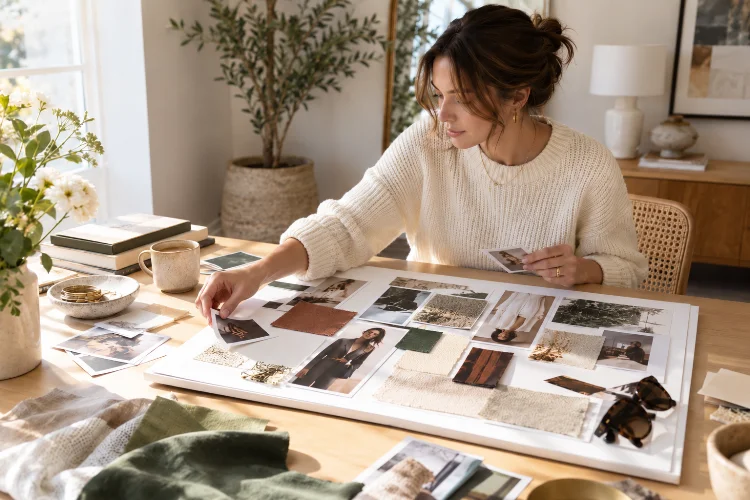
You can cut images from magazines, print photographs, add fabric samples, attach color swatches, and create something tactile.
Fashion designers often use materials and textile samples because texture can communicate things that photographs do not always capture clearly.
Milanote’s fashion mood-board guidance also highlights fabrics, sketches, color palettes, and accessory ideas as useful visual references.
Neither approach is better.
Choose whichever method you will actually enjoy using.
9. Compare the Mood Board with Your Current Wardrobe
This is probably the most important step.
Open your closet and compare it with your finished board.
Do they look like they belong to the same person?
If the answer is definately not, investigate why.
Maybe your mood board is full of relaxed neutral clothing, while your wardrobe contains brightly colored impulse purchases. Or perhaps your inspiration includes structured jackets, but you currently own none.
Do not immediately replace everything.
Instead, identify the gaps.
You might discover that buying one versatile blazer, better-fitting trousers, and a pair of simple loafers would move your wardrobe closer to your preferred style much more effectively than purchasing ten random trendy items.
Stitch Fix also recommends examining what you naturally gravitate toward when trying to define personal style, rather than treating style as something that must fit perfectly into a single category.
Your existing wardrobe can provide useful evidence too.
Pay attention to the clothes you wear repeatedly. Photograph your favorite outfits seperately and compare them with the mood board.
The overlap between inspiration and real life is often where your true style lives.
10. Use Your Mood Board as a Filter, Not a Rulebook
Your style board should help you make decisions, not trap you inside an aesthetic.
Fashion changes. Your lifestyle changes. You change.
Update the board every few months if necessary.
You might suddenly become interested in a new color, start working in a different environment, move somewhere with a new climate, or simply get tired of certain silhouettes.
That is completely normal.
A useful mood board evolves with you.
When shopping, ask simple questions: Does this item fit the general direction of my board? Can I combine it with several pieces I already own? Does it work with my lifestyle?
If the answer is yes, the purchase probably has a better chance of becoming something you actually wear.
If the answer is no, you may simply be responding to a temporary trend.
Creating a personal style mood board is not about designing the most beautiful Pinterest collage possible. Its real purpose is helping you understand what you consistently like and translating those preferences into practical wardrobe choices.
Start by defining the feeling you want, collect plenty of inspiration, identify repeating colors and silhouettes, and then edit everything down to the strongest visual ideas.
Most importantly, compare your inspiration with your real wardrobe.
Your mood board should reflect a version of your style that you can actually live in, not a fantasy closet designed for someone else’s life.
Once your board feels clear, use it when planning outfits, shopping, or deciding what your wardrobe is missing. Over time, you may find yourself buying fewer random pieces and creating outfits that feel much more like you.