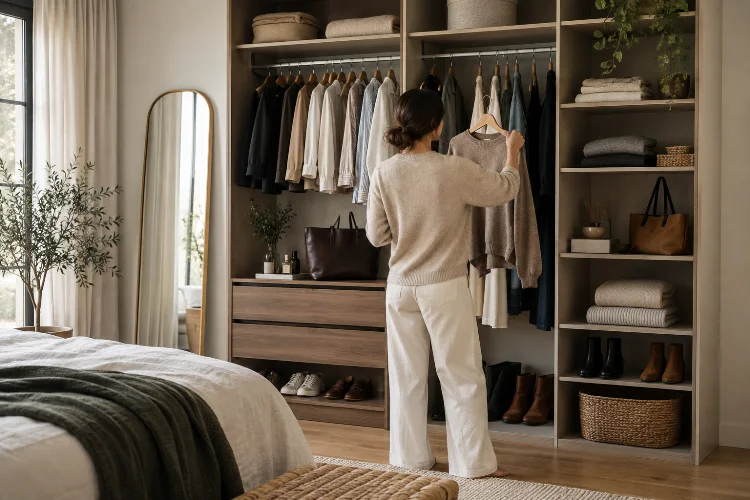
A beautiful wardrobe is not necessarily a useful wardrobe.
You can own perfectly tailored blazers, elegant dresses, designer shoes, and dozens of fashionable accessories and still feel like you have nothing to wear every morning.
Usually, the problem is not the number of clothes. It is the gap between the clothes you own and the life you actually live.
If you work from home five days a week, a closet dominated by formal officewear may not make sense. If you spend your weekends outdoors, delicate shoes and complicated outfits probably will not become your most-worn pieces.
Learning how to build a wardrobe that reflects your lifestyle means designing your closet around your routines, preferences, climate, work, social activities, and personal style.
The result does not need to be minimalist or boring. It simply needs to work.
Instead of chasing every new trend, you can create a collection of clothes that makes getting dressed easier, supports your daily activities, and still feels genuinely like you.
1. Start with Your Real Life, Not Your Ideal Life
Before buying anything new, look at how you actually spend your week.
This sounds simple, but it is one of the most important parts of wardrobe planning.
Imagine someone spends roughly 50% of their week working in a casual office, 25% doing everyday errands or relaxing, 15% socializing, and 10% attending more formal occasions.
Their wardrobe should probably reflect something close to that balance.
Yet many people shop for the most exciting 10% of their lives.
They buy party dresses, special shoes, vacation outfits, and statement pieces while ignoring the clothes they need every Monday morning.
Think about your typical month instead.
Where do you go? What do you do? How formal is your workplace? Do you walk frequently? Are you often indoors or outdoors? How often do you attend special events?
These answers reveal what your wardrobe actually needs.
A practical closet should support your normal routine first and your occasional activities second.
2. Audit What You Already Wear
You probably already own clues about your ideal wardrobe.
Open your closet and identify the clothes you wear repeatedly.
Maybe you constantly reach for straight-leg jeans, loose shirts, sneakers, neutral trousers, or lightweight jackets. Those repeated choices tell you something important about your real preferences.
Do not focus only on what looks fashionable.
Ask why certain pieces work.
Perhaps one pair of trousers is comfortable enough for commuting but polished enough for meetings. Maybe a particular jacket works with almost every shirt you own.
Those qualities are valuable.
Vogue’s wardrobe guides similarly emphasize versatile foundational pieces such as denim, shirts, trousers, outerwear, and everyday footwear that can be styled repeatedly rather than worn for only one specific look.
Also identify your neglected clothes.
If something has been hanging untouched for a year, ask why. Is it uncomfortable? Difficult to style? Too formal? The wrong color?
Understanding what you do not wear can be just as useful as knowing what you love.
3. Define Your Personal Style in a Few Words
Your lifestyle determines what clothes need to do. Personal style determines how you want those clothes to look.
Try describing your ideal style with three to five words.
You might choose:
“Relaxed, minimal, polished, practical.”
Someone else might choose:
“Colorful, creative, vintage, playful.”
These words give your wardrobe a direction without creating rigid rules.
Suppose your workplace requires smart-casual clothing but your personal style is relaxed and minimal. Instead of buying traditional suits, you might choose wide-leg trousers, simple knitwear, clean sneakers, and an unstructured blazer.
You are still dressing appropriately, but the clothes feel like you.
Personal style works best when it adapts to your lifestyle rather than fighting against it.
4. Build Around Your Most Important Clothing Categories
There is no universal list of wardrobe essentials.
A white button-down may be incredibly useful for one person and completely unnecessary for another.
Instead, identify the clothing categories that support your daily routine.
Someone who works in a corporate environment might need several trousers, shirts, blazers, and formal shoes. A freelance photographer may get more value from comfortable pants, durable jackets, T-shirts, and practical footwear.
A parent with young children might prioritize washable fabrics and comfortable silhouettes.
Your climate matters too.
There is little reason to build a wardrobe around heavy wool coats if you live somewhere warm all year.
Fashion editors often describe basics as the building blocks that make more distinctive pieces easier to wear. Vogue, for example, regularly highlights adaptable items such as denim, simple tops, trousers, jackets, and everyday shoes as foundations for different outfits.
The exact pieces, however, should depend on you.
5. Create Simple Outfit Formulas
One of the easiest ways to make a wardrobe more functional is to develop a few reliable outfit formulas.
An outfit formula is simply a combination of clothing categories that you know works.
For example:
Relaxed trousers + fitted T-shirt + overshirt + sneakers.
Another might be:
Straight jeans + button-down shirt + loafers + structured bag.
You do not need identical clothes every day. The formula stays the same while colors, fabrics, and individual pieces change.
This makes getting dressed faster because you are not building every outfit from zero.
Vogue’s styling coverage often takes a similar approach by combining familiar basics in different ways rather than suggesting that an entirely new wardrobe is necessary every season.
Try creating three or four formulas for the situations you experience most frequently.
One could be for work, one for casual days, one for social plans, and another for slightly dressier occasions.
Suddenly, your wardrobe starts behaving like a system.
6. Choose Colors That Work Together
A wardrobe becomes much easier to style when its colors communicate with one another.
That does not mean everything needs to be beige, black, or white.
Start with a few neutral or highly versitile colors that appear frequently in your outfits. Depending on your preferences, these might include navy, brown, cream, black, gray, denim blue, olive, or white.
Then add accent colors that make the wardrobe feel more personal.
Perhaps you love burgundy, cobalt blue, pink, or forest green.
When shopping, consider whether a new color works with several things you already own.
Imagine buying bright green trousers that match only one top.
Compare that with buying dark olive trousers that work with six shirts, two jackets, and three pairs of shoes.
The second option potentially creates far more outfits.
A coordinated palette does not limit creativity. It gives your clothes more opportunities to work together.
7. Buy for Versatility, but Do Not Remove Personality
A functional wardrobe does not need to look generic.
Basics create the foundation, but statement pieces create personality.
Perhaps most of your wardrobe consists of simple trousers, shirts, denim, and knitwear. You can still add an unusual jacket, patterned skirt, colorful sneakers, vintage handbag, or bold jewelry.
The trick is making sure those distinctive pieces can connect with your wardrobe.
Before purchasing something, imagine at least three outfits using clothes you already own.
If you cannot think of any, the item may become another isolated purchase.
This simple habit can reduce the familiar cycle of buying something exciting, wearing it once, and then forgetting about it.
Keeping clothing useful for longer also has broader benefits. The Ellen MacArthur Foundation notes that extending garment use through durability, repair, resale, and other approaches is an important part of reducing fashion’s wasteful linear model.
Versatility, therefore, can be good for both your closet and your consumption habits.
8. Pay Attention to Comfort and Maintenance
Sometimes we buy clothes for the person we imagine ourselves becoming.
Then real life arrives.
That silk shirt requires careful washing. Those shoes hurt after twenty minutes. The trousers wrinkle during your commute. The beautiful sweater is too warm for your local climate.
Practical details matter.
Check fabric care instructions before purchasing. Think about whether something needs ironing, dry cleaning, hand washing, or special storage.
Also consider physical comfort.
You are much more likely to repeatedly wear clothes that allow you to sit, walk, commute, work, and move naturally.
This does not mean everything has to resemble sportswear.
A well-fitted blazer can be comfortable. So can tailored trousers or a structured dress if the cut and fabric suit you properly.
Clothing designed to remain useful and desirable for longer depends partly on physical durability and partly on whether people continue wanting to wear it.
Comfort plays a major role in that relationship.
9. Shop for Gaps Instead of Random Items
Once you understand your wardrobe, shopping becomes much more strategic.
Instead of entering a store thinking, “What looks interesting?” ask, “What is my wardrobe missing?”
Perhaps you already own excellent trousers but lack casual tops.
Maybe you have enough clothing but need one pair of shoes that works across several ocassions.
Create a short shopping list based on genuine gaps.
This can protect you from impulse purchases that seem appealing but do not solve any real wardrobe problem.
It can also help you spend more intentionally.
If one high-quality jacket will be worn twice a week for several years, it may provide more value than several inexpensive jackets you rarely use.
Research summarized by the Ellen MacArthur Foundation has highlighted how clothing utilization has fallen significantly over time, reinforcing the value of keeping garments in active use for longer.
The goal is not simply buying less.
It is buying with a clearer reason.
10. Let Your Wardrobe Change When Your Life Changes
Your wardrobe should never become a permanent rulebook.
Life changes.
You may start a new job, move to another climate, begin exercising regularly, become a parent, travel more often, or simply discover a different personal style.
Your clothes should evolve with those changes.
Review your wardrobe every few months rather than waiting until it becomes completely overwhelming.
Notice what you are wearing more frequently and what has become less relevant.
You can alter garments, repair favorites, sell or donate suitable pieces, and gradually introduce items that fit your new circumstances.
Circular fashion approaches increasingly emphasize repair, resale, rental, and remaking as ways to extend the useful lives of clothing instead of automatically replacing it.
Your wardrobe should feel consistant with your current life, not the life you had five years ago.
Learning how to build a wardrobe that reflects your lifestyle begins with paying attention to your real routines.
Instead of following a universal checklist of fashion essentials, examine where you spend your time, what you already wear, which silhouettes feel comfortable, and what clothing categories genuinely support your daily activities.
From there, build around versatile staples, coordinated colors, useful outfit formulas, and a few personality-driven pieces.
You do not need to replace your entire closet at once.
Start small. Audit what you own, identify one or two genuine gaps, and make your next purchase intentionally.
Over time, your wardrobe can become easier to manage, easier to style, and much more representative of who you actually are-not just who fashion trends tell you to be.