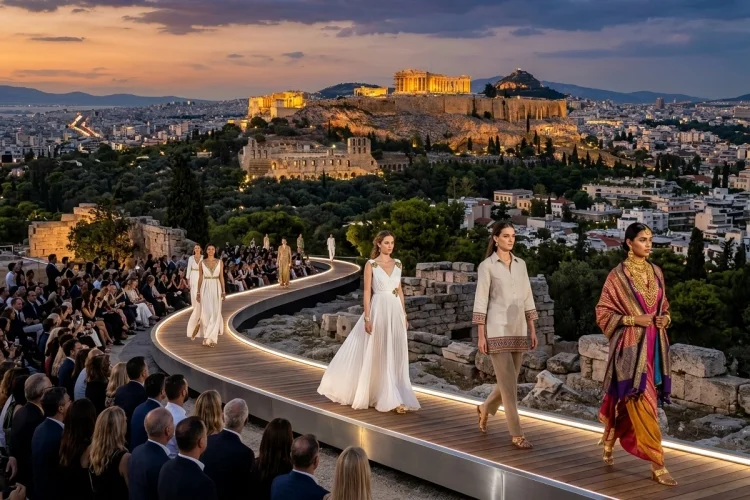
Open a modern wardrobe and you may find more ancient history than you expect. A loose summer tunic resembles garments worn around the ancient Mediterranean.
A pleated evening dress recalls Greek drapery, while a linen shirt uses a fibre that was highly valued in ancient Egypt.
Even modern accessories have historical connections. Belts, shawls, sandals, brooches, patterned borders, and statement jewellery were worn thousands of years before contemporary designers placed their own versions on runways.
Understanding how ancient civilisations influenced modern clothing does not mean claiming that every current trend was copied directly from the past.
Fashion develops through cultural exchange, technological change, trade, artistic interpretation, and repeated reinvention. Ancient Egypt, Greece, Rome, Mesopotamia, India, and China created distinctive ways of producing and wearing textiles.
Their ideas about draping, decoration, symbolism, luxury, and social identity continue to inspire fashion today. By examining these connections, we can see modern clothing as part of a much longer creative story.
Why Ancient Clothing Still Influences Fashion
Clothing rarely disappears completely from cultural memory. Shapes and decorative ideas can survive through sculpture, paintings, archaeological discoveries, written descriptions, traditional dress, and museum collections.
Modern designers often study these sources and translate historical details into contemporary garments. They may simplify an ancient silhouette, reproduce a decorative border, or use modern fabric to recreate the movement of a draped robe.
The influence is not always literal. A designer does not need to produce an exact historical costume to be inspired by the past. A one-shoulder dress, metallic collar necklace, or pleated gown can suggest antiquity while remaining completely modern.
Fashion also tends to move in cycles. Ancient references return because they offer familiar visual ideas-elegance, power, luxury, heroism, spirituality, or simplicity-that can be reinterpreted for new audiences.
Ancient Egypt Popularised Linen, Pleats, and Bold Accessories
Ancient Egyptian clothing was strongly connected to climate, available materials, religion, and social status. Linen, made from flax, became especially important because it could be produced in different weights, from practical cloth to remarkably fine material.
The Metropolitan Museum of Art holds exceptionally sheer New Kingdom linen described as the highest-quality “royal linen.” Its lightness supports artistic depictions of finely pleated garments that followed the shape of the body.
That combination of lightweight fabric and controlled pleating still appears in summer dresses, formal gowns, wide trousers, and resort wear. Designers use pleats to create movement without adding complicated tailoring.
Jewellery as Part of the Outfit
Ancient Egyptian appearance also relied on jewellery, collars, belts, amulets, and carefully arranged headwear. These accessories did more than decorate the body; they could communicate rank, religious belief, protection, and wealth.
Modern collar necklaces, geometric cuffs, metallic belts, scarab motifs, and dramatic eye makeup often reference this visual language. The result may be glamorous rather than historically exact, but the influence remains recognisable.
Egypt also demonstrates an important fashion principle: a simple garment can look powerful when fabric quality, proportion, colour, and accessories are carefully coordinated.
Ancient Greece Gave Fashion the Art of Draping
Ancient Greek clothing was often created from rectangular pieces of fabric rather than heavily shaped patterns. The main garments included the chiton, peplos, and himation, which could be wrapped, pinned, belted, folded, or arranged in different ways.
The chiton was generally formed from lightweight fabric joined and fastened around the body. The peplos used a folded upper section, while the himation was a larger cloak draped over the shoulders or around the figure.
These basic constructions produced an impressive variety of silhouettes. Changing the position of a belt, pin, fold, or shoulder fastening could transform the entire appearance.
From Greek Drapery to Modern Eveningwear
The influence of Greco-Roman dress has continued for more than two thousand years.
The Metropolitan Museum of Art documents how designers repeatedly returned to classical garments, adapting their drapery, high waistlines, one-shoulder shapes, and flowing proportions.
Empire-waist dresses, pleated evening gowns, column dresses, cape-like layers, and asymmetrical necklines all show this connection. Designers such as Mariano Fortuny and Madame Grès became particularly famous for garments that transformed classical drapery into modern couture.
Even the Greek-key border remains common on clothing, bags, jewellery, and footwear. It is a simple geometric motif with an unusually long fashion life.
Rome Helped Establish the Tunic and Layered Dressing
Roman clothing borrowed ideas from neighbouring cultures while developing its own system of social dress.
The tunic became a basic garment for different groups across the Roman world, while cloaks, togas, stolas, belts, and decorative borders could communicate role or status.
The tunic’s basic T-shaped construction remained influential long after the western Roman Empire ended. Related forms continued through late antiquity and Byzantium, where tunics were worn in layers and could feature decorative woven bands or medallions.
Modern T-shirts, shift dresses, kaftan-like tops, and loose tunic blouses are not identical to Roman garments. However, they share the practical idea of creating wearable clothing from relatively simple body and sleeve shapes.
Roman-style sandals have also returned repeatedly. Straps crossing the foot, ankle, or lower leg appear in contemporary footwear marketed as gladiator sandals, showing how a practical ancient construction can become a recurring fashion trend.
Mesopotamia and Persia Showed the Power of Pattern and Status
Ancient Mesopotamian and Persian clothing is often studied through sculpture and surviving images because textiles rarely survive for thousands of years. Reliefs show layered garments, fringed edges, belts, decorated robes, and carefully arranged hairstyles and beards.
At the Assyrian capital of Nimrud, carved details record geometric and floral patterns that probably represented embroidered clothing and luxurious palace textiles.
These traditions helped establish an idea that remains central to fashion: fabric decoration can communicate authority. Embroidery, patterned borders, metallic thread, tassels, and richly decorated outer garments still create associations with ceremony, status, and luxury.
Ancient trade routes through Mesopotamia and Persia also connected eastern and western cultures. Materials, motifs, dyes, and clothing ideas moved with merchants and travellers rather than remaining within fixed borders.
Modern fashion works in a similar way. A textile technique may develop in one region, travel through trade, and eventually be reinterpreted by designers and consumers elsewhere.
Ancient Indian Textiles Shaped Global Colour and Pattern
India has one of the world’s longest and richest textile histories. The V&A notes that handmade Indian textile traditions date back at least 6,000 years and are deeply connected to the country’s cultural identity.
Indian craftspeople developed sophisticated methods of weaving, dyeing, printing, resist decoration, and embroidery. Cotton fabrics and colourful patterned textiles later travelled widely through international trade.
The influence can be seen in printed dresses, embroidered jackets, paisley patterns, lightweight cotton clothing, decorative scarves, and modern interest in artisanal fabric production.
Draped garments also demonstrate how a length of textile can create many silhouettes without being cut into complex pattern pieces.
The sari remains a living clothing tradition rather than merely an archaeological style, and its draping, colour combinations, borders, and textile craftsmanship continue to inspire global designers.
This influence should be approached respectfully. Using a general draping technique is different from copying culturally meaningful garments or sacred motifs without understanding their origins.
Ancient China Made Silk a Global Luxury
Chinese civilisation played a foundational role in the history of silk. Early surviving Chinese silk fragments demonstrate advanced weaving and dyeing, while later textiles carried complex images of animals, birds, dragons, clouds, flowers, and geometric forms.
Silk was light, strong, smooth, and capable of displaying rich colour. Its value helped create trading networks connecting China and Central Asia with regions farther west.
Through these routes, textiles carried more than material. Motifs, production knowledge, colours, and artistic styles moved between cultures. The Met notes that costly silks and embroideries became important vehicles for the migration of designs across Asia.
Silk remains associated with luxury clothing, eveningwear, scarves, linings, shirts, and accessories. Brocade, satin surfaces, embroidered robes, stand collars, and symbolic patterns also appear regularly in modern collections inspired by Chinese dress.
As with Indian textiles, designers need to distinguish informed appreciation from shallow imitation. A garment becomes more meaningful when its references are researched, acknowledged, and treated with care.
Ancient Ideas Still Shape Modern Wardrobes
Ancient civilisations influenced more than individual garments. They established design methods that remain useful today.
Draping allows fabric to shape itself around the body. Belting changes proportion without complex construction. Layering makes clothing adaptable, while borders and embroidery turn simple shapes into distinctive garments.
Ancient clothing also reminds us that accessories are not secondary. Brooches once fastened garments while adding decoration. Belts provided structure, jewellery communicated identity, and sandals combined protection with visual design.
However, modern fashion often creates an idealised version of antiquity. Ancient Greek clothing, for example, was frequently colourful and patterned, even though later designers associated classical dress with white marble and pale fabric.
The white image partly developed because much of the original colour on ancient sculpture disappeared over time.
Fashion history is therefore not a process of copying the past perfectly. It is a process of selecting, transforming, and sometimes misunderstanding historical ideas.
Ancient civilisations continue to influence modern clothing through materials, silhouettes, decorative techniques, accessories, and methods of construction.
Egypt contributed enduring associations with linen, pleating, and statement jewellery. Greece and Rome inspired draped dresses, tunics, cloaks, sandals, and classical motifs.
Mesopotamian and Persian traditions demonstrated the visual power of embroidery and ceremonial clothing. India developed textile, colour, printing, and draping traditions that travelled around the world, while China made silk one of history’s most influential luxury materials.
Look closely at your wardrobe and choose one item with pleats, embroidery, draping, a tunic shape, or patterned borders. Research the history behind that detail. Understanding its origins can turn an ordinary garment into evidence of thousands of years of human creativity.