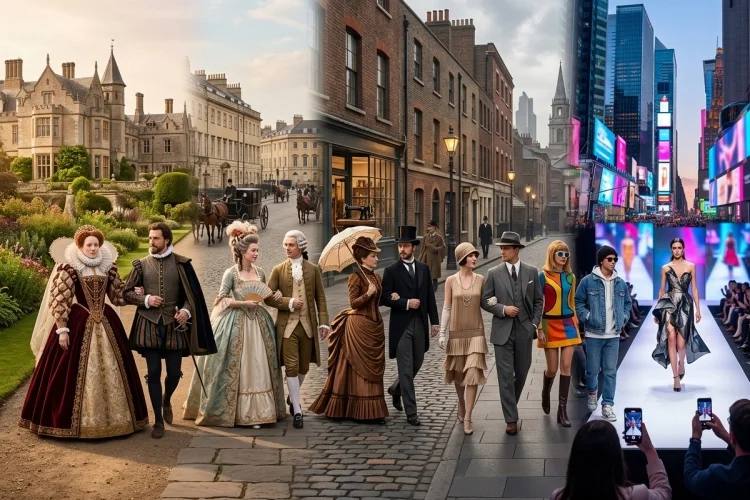
Look at a portrait from 500 years ago and the clothing may seem completely unfamiliar. The sleeves are larger, the fabrics look heavier, and even the basic shape of the body appears different.
Yet those outfits served many of the same purposes as clothes today: protection, identity, status, belonging, and self-expression. A brief history of fashion through the centuries shows that style never develops in isolation.
Politics, religion, trade, technology, war, entertainment, and changing ideas about gender have all influenced what people wear. Fashion history is also global. Every region has its own textile traditions, forms of dress, and cultural meanings.
However, this beginner-friendly overview focuses mainly on the development of the European and North American fashion system, particularly because it later shaped the international couture, ready-to-wear, and mass-market industries.
From handmade garments and royal wardrobes to sewing machines, miniskirts, streetwear, and live-streamed runway shows, the evolution of clothing tells a much bigger story about society itself.
Ancient and Medieval Clothing: Function, Culture, and Status
Before fashion became an organised industry, clothing was mainly produced within households or by local craftspeople. The available materials depended on geography, trade, climate, and social position.
Ancient societies developed their own sophisticated textile traditions. Garments could be wrapped, draped, pinned, belted, or sewn, while colour, decoration, and fabric quality often communicated wealth or rank.
During the medieval period, most clothing was still handmade and relatively expensive. Garments were repaired, altered, reused, and passed between people rather than quickly discarded.
Elite clothing featured finer textiles, elaborate embroidery, fur, metallic thread, and vivid dyes. Working people generally wore more practical garments made from locally available materials.
The V&A’s textile collection includes more than 75,000 objects spanning over 5,000 years, demonstrating the enormous historical variety of weaving, printing, embroidery, lace, tapestry, and other textile techniques.
The Renaissance and Seventeenth Century: Clothing as Power
During the Renaissance, fashion became increasingly important at wealthy European courts. Clothing offered rulers, nobles, and merchants a visible way to display prosperity and political influence.
Silk, velvet, brocade, lace, pearls, and embroidery appeared in elite wardrobes. Structured bodices, wide sleeves, fitted doublets, ruffs, and carefully shaped garments created imposing silhouettes.
Fashion was not simply personal. Court dress could be governed by rules about which colours, fabrics, or decorations different social groups were permitted to wear.
Portraits became valuable records of clothing from this period. Artists carefully represented fabric texture, jewellery, lace, and decorative details because dress helped communicate the subject’s identity and status.
International trade also influenced European wardrobes. Fabrics, dyes, techniques, and decorative ideas moved between regions, showing that historical fashion was shaped by cultural exchange rather than developing within isolated countries.
The V&A’s fashion collection contains rare surviving seventeenth-century gowns and other garments that document these changing shapes and methods of construction.
Eighteenth-Century Fashion: Courtly Luxury and Elaborate Silhouettes
The eighteenth century is remembered for highly decorative European court fashion. Wealthy women wore gowns supported by structured undergarments, while fashionable men could appear in colourful coats, waistcoats, breeches, stockings, and carefully styled accessories.
Fabric was extremely valuable. Silk weaving, embroidery, lace, ribbons, buttons, and surface decoration could require enormous amounts of skilled labour.
Many garments were custom-made by tailors or dressmakers. Rather than visiting a shop filled with ready-to-wear sizes, wealthy customers commissioned clothing that was fitted to their bodies and adjusted to personal taste.
The V&A notes that the greatest expense of an eighteenth-century dress was often the textile rather than its basic construction. Clothing also tended to change more slowly, and formal garments could be worn repeatedly, remodelled, or dyed another colour.
Fashion ideas spread through courts, travellers, dolls, illustrations, and printed fashion plates. Paris became particularly influential, establishing a reputation that would later help it become the centre of haute couture.
The Nineteenth Century: Industrialisation Changes Clothing
The Industrial Revolution transformed how textiles and garments were produced. Mechanised spinning, weaving, printing, and sewing allowed clothing to be made more quickly and in larger quantities.
The sewing machine was especially important. The Smithsonian notes that the ready-made clothing industry adopted sewing machines rapidly during the 1850s because they saved considerable time compared with hand sewing.
Printed magazines and fashion plates also helped trends travel faster. Consumers could see new silhouettes without visiting royal courts or major cities.
Nineteenth-century women’s fashion changed through several dramatic shapes. Large sleeves appeared in some periods, while crinolines supported wide skirts during the mid-century. Bustles later shifted the volume towards the back.
These shapes were often created by underwear and hidden structures. Corsets shaped the torso, steel-hooped crinolines held skirts away from the legs, and bustles projected fabric behind the body.
This century also saw the rise of the modern fashion designer. Charles Frederick Worth developed an influential Paris fashion house, presented seasonal designs to clients, and became closely associated with the emergence of haute couture.
The Early Twentieth Century: Fashion Becomes Modern
At the beginning of the twentieth century, formal clothing remained structured and detailed. However, social change, new activities, artistic movements, and two world wars gradually encouraged simpler and more practical styles.
Designers such as Paul Poiret experimented with looser shapes during the 1900s and 1910s. Women’s clothing began moving away from some of the heavily structured silhouettes associated with the previous century.
The First World War affected materials, labour, and daily routines. Although fashion did not transform overnight, simpler pre-war styles helped prepare the way for the shorter skirts and straighter silhouettes of the 1920s.
The 1920s became famous for the flapper look. Dropped waists, shorter hemlines, bobbed hair, dance-friendly dresses, and sportswear reflected a more energetic image of modern life.
Gabrielle “Coco” Chanel helped popularise comfortable jersey, relaxed separates, simple black dresses, and an understated approach to luxury. Her personal image and designs had a major influence on twentieth-century ideas of modern style.
Post-War Fashion: Couture, Teenagers, and Youth Culture
The Second World War brought fabric restrictions, practical clothing, uniforms, and reduced decoration in many countries. After years of austerity, post-war fashion often returned to luxury and carefully constructed silhouettes.
Christian Dior’s 1947 “New Look” featured rounded shoulders, defined waists, and full skirts. It became internationally successful and strongly influenced women’s fashion during the 1950s.
At the same time, everyday wardrobes were becoming more casual. Ready-to-wear clothing expanded, department stores grew, and television, film, and popular music introduced new style icons to mass audiences.
Young consumers became especially influential during the 1960s. London designers and boutiques helped create a separate youth market, while miniskirts, bold prints, synthetic materials, and Space Age designs challenged older ideas of respectable dress.
During the 1970s, 1980s, and 1990s, fashion became increasingly diverse. Punk used torn clothing, leather, safety pins, and DIY styling as rebellion.
Hip-hop influenced sportswear, trainers, jewellery, and oversized silhouettes, while designers repeatedly borrowed from street culture, music, historical dress, and global textile traditions.
There was no longer one dominant silhouette that everyone was expected to follow. Fashion became a collection of competing identities and subcultures.
Fashion in the Twenty-First Century
Today, style moves at remarkable speed. Runway images, celebrity outfits, street photography, and social-media posts can reach international audiences within seconds.
The fashion show has evolved from a private presentation for wealthy clients into a global media event. Alexander McQueen’s Plato’s Atlantis show for Spring/Summer 2010 became the first fashion show broadcast live over the internet through SHOWstudio.
Technology also influences garment creation. Designers can use computer modelling, laser cutting, seamless knitting, bonding, and three-dimensional printing alongside traditional hand techniques.
Modern fashion is more inclusive than many earlier systems, although inequalities remain. Designers and consumers increasingly question narrow expectations concerning body size, gender, ethnicity, disability, beauty, and cultural representation.
Sustainability has also become central to the fashion conversation. The modern industry faces growing pressure to reduce overproduction, textile waste, hazardous pollution, and dependence on virgin resources while improving circularity and working conditions.
Fashion today is simultaneously global and personal. Someone can combine vintage tailoring, traditional textiles, contemporary trainers, second-hand clothing, and digital inspiration in one outfit.
Why Fashion History Still Matters
Fashion history helps explain why modern wardrobes contain such a strange mixture of old and new ideas.
Blazers developed from earlier tailored garments, platform shoes have appeared in several historical cultures, and current oversized silhouettes often reinterpret shapes from previous decades.
Designers regularly return to archives for inspiration. Corsets, bustles, flapper dresses, 1940s tailoring, 1960s miniskirts, and 1990s minimalism continue to reappear in updated forms.
Studying historical clothing also reveals that fashion rules are temporary. Colours, fabrics, and silhouettes that once represented masculinity, femininity, respectability, or rebellion may carry completely different meanings today.
History therefore makes fashion easier to understand. Trends rarely come from nowhere-they usually revive, modify, or react against something that came before.
The history of fashion is a story of changing bodies, materials, technology, labour, and identity.
Clothing moved from locally produced garments and exclusive court dress to industrial manufacturing, haute couture, ready-to-wear, youth culture, streetwear, and global digital fashion.
Each period created its own silhouettes, but fashion was never only about appearance. What people wore reflected status, work, politics, gender expectations, cultural exchange, and access to technology.
The next time you notice a new trend, look for its historical influences. Explore a museum archive, examine an old family photograph, or compare today’s outfits with clothing from an earlier decade.
Understanding where styles come from can make fashion more meaningful-and show that even the newest look may have a surprisingly long history.