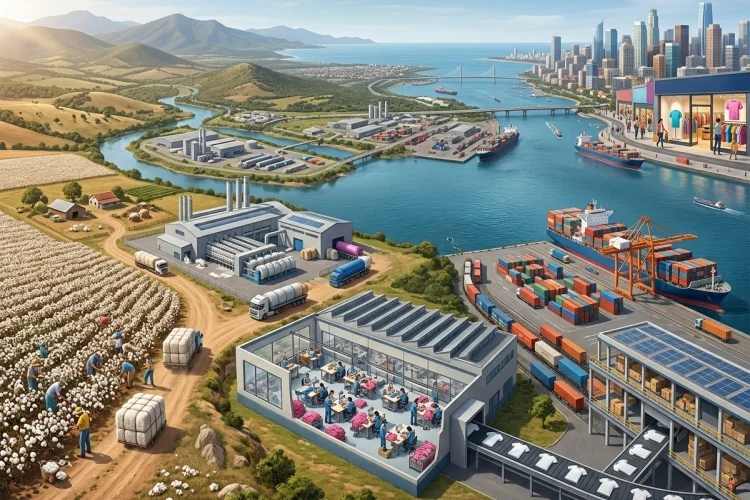
A T-shirt can look like one simple product, but its journey may involve farms, chemical plants, spinning mills, dye houses, garment factories, warehouses, shipping companies, and retail stores across several countries.
The cotton might be grown in one country, spun into yarn in another, knitted and dyed somewhere else, and finally cut and sewn hundreds of kilometres away. After that, the finished shirt must still be inspected, packed, transported, marketed, and delivered to a shop or customer.
This is why fashion supply chains explained from fibre to store can seem complicated. Clothing production is not one straight factory process. It is a global network of businesses and workers completing different stages.
The scale is enormous. Textile Exchange reports that global fibre production reached approximately 132 million tonnes in 2024, more than double the volume produced in 2000.
Understanding this journey helps you see where clothing prices, quality problems, labour risks, environmental impacts, and delivery delays come from.
What Is a Fashion Supply Chain?
A fashion supply chain includes every stage and organisation involved in turning raw materials into products that customers can buy.
It begins with resources such as cotton, wool, wood pulp, or petroleum-based chemicals. It then moves through yarn production, textile manufacturing, dyeing, garment assembly, transportation, distribution, and retail.
Many companies describe suppliers using tiers. Tier 1 usually covers factories performing final activities such as cutting, sewing, finishing, and packing. Earlier tiers may include textile mills, dyeing facilities, yarn producers, and raw-material suppliers.
However, tier definitions are not completely standard. One brand may classify a fabric mill as Tier 2, while another uses a slightly different system. The important point is that the most visible factory is only one part of a much longer production chain.
Fashion Revolution has argued that brands need to disclose suppliers beyond Tier 1 because serious environmental and social risks can also occur during fabric production and raw-material processing.
Stage 1: Producing the Raw Fibres
Every textile begins with a fibre. Natural fibres come from plants or animals, while synthetic materials are manufactured through chemical processes.
Cotton grows around the seeds of the cotton plant. Wool commonly comes from sheep, while linen is produced from flax. Viscose and lyocell begin with cellulose, usually sourced from wood.
Polyester and nylon are generally produced from fossil-based chemicals. Polyester alone represented around 59% of global fibre production in 2024, showing how important synthetic materials have become within the modern textile market.
Raw-material production can involve farmers, livestock businesses, forestry operations, recycling companies, and petrochemical producers. Its environmental effects may include land use, water consumption, greenhouse gas emissions, fertilisers, pesticides, and fossil-resource extraction.
At this early stage, the material may still be far removed from the brand name eventually printed on the label.
Stage 2: Turning Fibres Into Yarn
Loose fibres must usually be cleaned and processed before becoming yarn.
Cotton may be separated from its seeds, while wool needs cleaning and grading. Synthetic fibres are produced as filaments or cut into shorter lengths that can be handled more like natural fibres.
The fibres are then spun or twisted together to create yarn. The thickness, strength, twist, and texture of that yarn will influence the final fabric.
Fine yarn may be used for lightweight shirts, while thicker yarn can create denim, knitwear, or heavy outerwear. Blended yarns combine materials, such as cotton with polyester or wool with nylon.
This stage may take place in a specialised spinning mill that supplies several textile manufacturers. The fashion brand may have no direct commercial relationship with that mill, which can make full supply-chain tracing difficult.
Stage 3: Making and Finishing the Fabric
Yarn is transformed into fabric through techniques such as weaving or knitting.
Woven fabric is created by crossing sets of yarn, while knitted fabric uses connected loops. A woven cotton poplin shirt therefore behaves differently from a knitted cotton T-shirt, even when both labels say 100% cotton.
The unfinished material may then be bleached, dyed, printed, washed, coated, brushed, or softened. These processes determine its colour, texture, water resistance, shine, and overall performance.
Textile processing can require large amounts of energy, water, and chemicals. Poorly controlled dyeing and finishing may create risks for workers, nearby communities, and waterways.
UNEP’s textile roadmap identifies improved production practices, changing consumption patterns, and investment in circular infrastructure as major priorities for reducing harm across the textile value chain.
Before accepting a bulk fabric order, brands may test its shade, shrinkage, strength, stretch, pilling, and colourfastness.
Stage 4: Designing and Developing the Garment
While materials are being sourced, designers and product teams develop the garment itself.
A designer creates the silhouette, colour, details, and overall appearance. A technical designer converts that creative idea into measurements and construction instructions.
The information is often organised in a tech pack. This document may include technical drawings, fabric specifications, stitching, trims, labels, garment measurements, packaging, and quality requirements.
A patternmaker creates the shapes that will be cut from the fabric. A sample is then produced so the team can examine its appearance, fit, movement, and construction.
Several revisions may be needed. The sleeves might feel restrictive, the fabric may not drape as expected, or the production cost may exceed the target price.
Once the design, sample, materials, and price are approved, the brand places a bulk order with a manufacturer.
Stage 5: Cutting, Sewing, and Finishing
At the garment factory, layers of fabric are arranged and cut according to the approved patterns.
The pieces are sorted into bundles and moved to sewing lines. In large factories, each worker may complete one specialised operation, such as attaching sleeves, making pockets, sewing collars, or finishing hems.
The garment then moves through pressing, trimming, button attachment, washing, labelling, and inspection. Some products require specialised treatments, such as garment dyeing, embroidery, printing, distressing, or waterproof finishing.
This final assembly stage is commonly described as Tier 1. It is also the part of the supply chain most frequently disclosed by major fashion companies, although transparency becomes less common further upstream.
Brands can strongly influence factory conditions through the prices they negotiate, the deadlines they set, and the frequency with which they change orders.
ILO research has examined how purchasing practices can affect wages, working hours, employment arrangements, and workplace conditions.
Stage 6: Quality Control and Packaging
Quality control can happen throughout production rather than only after the garment is complete.
Inspectors may check fabric defects, cutting accuracy, seam strength, measurements, colour consistency, labels, and packaging. Finished items are usually compared with the approved sample and technical specifications.
Not every garment must have exactly identical measurements. Brands normally allow a small tolerance, but products outside that range may need correction or rejection.
After approval, garments are folded or placed on hangers, fitted with price tags, and packed into protective bags and cartons. Cartons are labelled with product codes, quantities, colours, and destination information.
Accurate packing matters because retailers may receive thousands of similar products. A mistake at this stage can send the wrong size or colour to an entire store or distribution centre.
Stage 7: Shipping and Distribution
Finished garments may travel by truck, rail, cargo ship, or aeroplane.
Sea freight is commonly used for large international orders because it is generally cheaper than air transport. However, it takes longer, so brands must plan production well before the intended selling season.
Air freight is faster but usually more expensive. Companies may use it when production is delayed or when a product must reach the market quickly.
Customs procedures, import duties, port congestion, extreme weather, conflict, strikes, and transport disruptions can all affect delivery.
The World Trade Organization describes textiles and clothing as a global value chain in which production and commercial activities are divided across different economies.
Once imported, the clothes usually enter a distribution centre. They are then divided between physical shops, online warehouses, department stores, and other retail partners.
Stage 8: Retail, Returns, and Unsold Stock
At the retail stage, products are photographed, marketed, priced, displayed, and sold.
The retail price must cover more than manufacturing. It may also include design, product development, transportation, duties, warehousing, staff, rent, marketing, payment fees, returns, discounts, and company profit.
Online retail has made fashion more convenient, but it has also created logistical pressure. Companies must process individual orders, offer fast deliveries, manage product tracking, and handle large volumes of returns.
Products that sell slowly may be discounted or transferred to outlet stores. Unsold garments might also be resold through liquidation businesses, donated, recycled, stored, or destroyed, depending on company policy and local law.
A supply chain therefore does not truly finish at the store. Returned, damaged, and unwanted clothing creates another chain involving repairers, resale platforms, charities, waste companies, and recyclers.
Why Transparency and Traceability Matter
Transparency means publicly sharing information about suppliers and business practices. Traceability means being able to follow a material or product through different stages.
Both are important because brands cannot manage risks they do not identify. A company may know which factory sewed its shirt but remain uncertain about the origin of the cotton, the chemicals used in dyeing, or the working conditions in subcontracted facilities.
The OECD recommends a due-diligence process in which fashion companies identify, prevent, reduce, track, and communicate how they address negative impacts across garment and footwear supply chains.
Transparency does not automatically prove that a company is responsible. However, supplier information allows workers, unions, governments, researchers, and customers to examine claims and respond when problems occur.
A fashion supply chain takes clothing through raw-material production, spinning, textile manufacturing, dyeing, design, sampling, cutting, sewing, quality control, shipping, and retail.
After purchase, returns, repairs, resale, recycling, and disposal extend the journey even further. Each stage affects the garment’s price, appearance, performance, labour conditions, and environmental footprint.
The brand on the label coordinates much of this process, but countless suppliers and workers contribute to the finished product. The next time you buy clothing, check its fibre content, manufacturing country, construction, care instructions, and brand transparency.
Learning what happened before the garment reached the store can help you judge its real value-and make more informed choices about what you purchase, wear, repair, and keep.